Introduction
Introduction
On paper, we are a solo indie venture. In reality, we are a collective of gamers, writers, and artists building a new standard for mobile entertainment. We reject the lazy, predatory loops of modern app stores to engineer deep, immersive titles with absolute technical intent. Our roadmap spans from the heavy psychological tension of single-player horror to the raw, tactical precision of non-pay-to-win multiplayer arenas. We treat mobile hardware with the respect it deserves—and we build games that demand yours.
Why We are Unapologetically Mobile ?
Growing up, I (The Founder) didn't have a high-end, beastly gaming PC that could run the latest AAA blockbusters. I had a phone. Mobile was my gateway to gaming, my entertainment, and my escape.
Today, I finally have that powerful workstation setup, but when I look back at the mobile storefronts, it breaks my heart. The app stores are flooded with low-effort slop, mindless hyper-casual gate runners, and digital babysitters designed for seven-year-olds. Mobile hardware has become incredibly powerful and affordable, yet the software has largely retreated into lazy, predatory loops.
We are here to rebel against that.
Gaming as the Ultimate Entertainment
We believe interactive gaming is the absolute highest form of entertainment. Unlike watching an OTT show or mindlessly scrolling through a video feed when you have sleep issues, gaming demands your attention, your reflexes, and your mind. It engages you completely.
And you shouldn’t be forced to sit upright at a desk with an expensive console or PC just to enjoy a high-quality gaming experience. You deserve core, mature entertainment while relaxing on a couch, traveling, or winding down at night. Mobile gaming has traditional flaws—like clunky on-screen touch controls—but our goal is to optimize our games so perfectly that those barriers completely melt away. We want you to forget you are looking at a glass screen and feel like you are directly inside a living, breathing world. 
Our Roadmap: From Nightmares to Arenas
We are a studio built on long-term vision, not quick cash-grabs. We have a definitive roadmap to bring entirely new, never-before-seen mechanics to the palm of your hand.
Current Phase: The Malvior Experiment
Right now, our primary focus is our debut title, The Malvior Experiment. Inspired by atmospheric, tense escape games like Granny and Evil Nun, it is a mature, puzzle-solving horror experience where players must complete high-stakes missions to escape a brilliant but mad scientist.
The Future Dream: Non-Pay-To-Win Multiplayer
If The Malvior Experiment succeeds, we plan to anchor ourselves in the horror genre for 4 to 5 more titles to build a rock-solid foundation. If it falls short of expectations, we will dust ourselves off and try one or two more. Why? Because our ultimate dream is to build massive, skill-based multiplayer games inspired by tactical experiences like Bedwars.
Multiplayer infrastructure is incredibly expensive to develop and maintain. To get there, we need capital. Let’s be completely honest: Money is not our ultimate goal; money is the tool to fund the revolution we are dreaming of.
When we do launch multiplayer titles, they will feature leaderboards, social networking, and item systems, but we hold an unbreakable moral line: No Pay-To-Win. Ever. We want to generate piles of cash, but we will do it by leveraging absolute quality and unparalleled player experiences to attract a massive community. For our horror titles, we will never flood your screen with annoying banner ads; instead, we limit monetizing to respectful video ads during death/respawn cycles or rewarded ads for an extra life. We will always choose sustainable quality over greedy design.
Behind the Screen: Code & Architecture
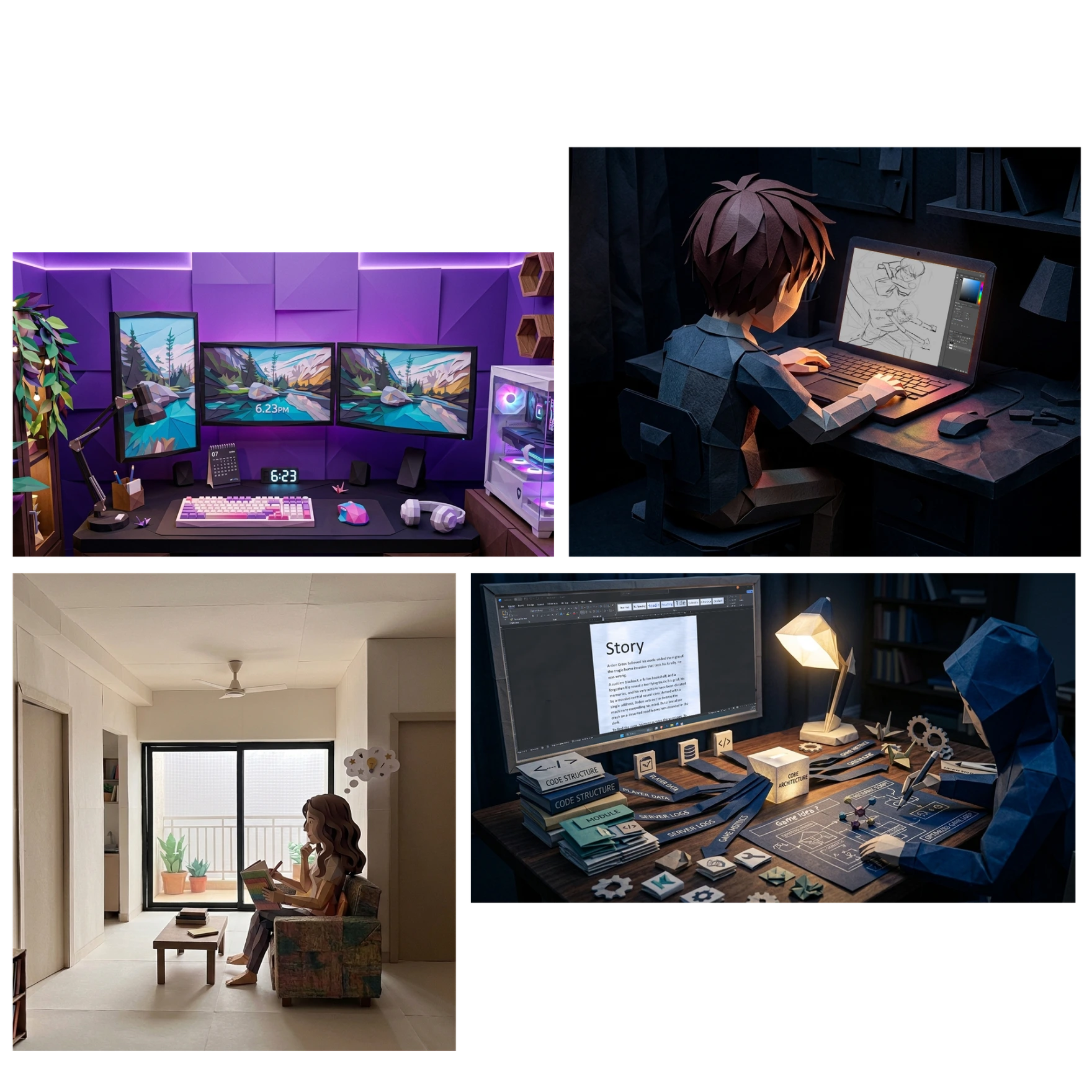
Great games aren't just built; they are structurally engineered. While the global framework of our studio thrives on shared creative counseling and collaborative feedback from a trusted circle of writers, animators, and tech advisors, the actual structural engineering—the heavy technical lifting—happens at a singular desk.
Every single line of gameplay architecture, mechanics scripting, and core game loop design is meticulously hand-coded and engineered from scratch. By keeping the technical execution tightly controlled and centralized, we ensure that every mechanic operates with absolute intent, resulting in highly optimized, unified mobile experiences where the tech seamlessly serves the design.
Solo Execution, Squad Soul
On paper, Origamiz Studios operates as a solo indie venture. I write the code, manage the mobile optimization, build the website, and handle the publishing. But a project with this much emotion cannot be built in total isolation.
From the very beginning, I have been backed by a tight-knit squad of incredibly experienced friends whose advice, critiques, and talents are woven into the fabric of this studio. I consider them my team, and they deserve the credit:
Divanshi Chib: The creative mind who wrote the narrative, script, and lore that brings games to life.
Kartikey: The talented hand who helped shape our 2D animations and constantly pushes our User Interface (UI) and User Experience (UX) to be clean, intuitive, and immersive.
Manish Kumar: The man behind prototyping in early phases of our multiplayer games.
Our Tech Advisers: Brilliantly skilled friends in App and Web Development who keep our technical foundations sharp.
We aren't a corporate boardroom trying to read a spreadsheet of market trends. We are gamers, writers, and artists building the mature mobile experiences we always wanted to play. Welcome to Origamiz Studios.
We are a studio built on long-term vision, not quick cash-grabs. We have a definitive roadmap to bring entirely new, never-before-seen mechanics to the palm of your hand.
Current Phase: The Malvior Experiment
Right now, our primary focus is our debut title, The Malvior Experiment. Inspired by atmospheric, tense escape games like Granny and Evil Nun, it is a mature, puzzle-solving horror experience where players must complete high-stakes missions to escape a brilliant but mad scientist.
The Future Dream: Non-Pay-To-Win Multiplayer
If The Malvior Experiment succeeds, we plan to anchor ourselves in the horror genre for 4 to 5 more titles to build a rock-solid foundation. If it falls short of expectations, we will dust ourselves off and try one or two more. Why? Because our ultimate dream is to build massive, skill-based multiplayer games inspired by tactical experiences like Bedwars.
Multiplayer infrastructure is incredibly expensive to develop and maintain. To get there, we need capital. Let’s be completely honest: Money is not our ultimate goal; money is the tool to fund the revolution we are dreaming of.
When we do launch multiplayer titles, they will feature leaderboards, social networking, and item systems, but we hold an unbreakable moral line: No Pay-To-Win. Ever. We want to generate piles of cash, but we will do it by leveraging absolute quality and unparalleled player experiences to attract a massive community. For our horror titles, we will never flood your screen with annoying banner ads; instead, we limit monetizing to respectful video ads during death/respawn cycles or rewarded ads for an extra life. We will always choose sustainable quality over greedy design.
Our Core Game Design Principles
Our studio operates on an unyielding set of development philosophies, split between the psychological depths of single-player experiences and the mechanical precision of competitive multiplayer arenas.
Single-Player, Narrative & Immersion
Clear, Compelling Objectives: Every player journey requires a North Star. Whether a player is fighting for a monumental cause, managing scarce resources to escape a threat, or navigating overlapping motivations, the psychological weight of why they are pushing forward is always explicit and earned.
Environmental Storytelling: We believe the highest form of immersion happens when the narrative speaks through the world itself, rather than linguistic hand-holding. By deliberately placing structural clues, environmental details, or subtle visual remnants, we challenge the player to observe, analyze, and deduce the history of the space on their own terms.
Atmospheric Tension: True dread is grown, not forced. Just as in masterclass cinema, our worlds use dynamic lighting, thick shadows, and calculated silence to build psychological tension. The atmosphere does the heavy lifting of generating raw emotion long before a threat ever manifests.
Consequential Agency: Player decisions carry weight. We design our single-player experiences with the philosophy that choice should matter—ensuring key narrative forks permanently alter the state of the world, character fates, or the ultimate trajectory of the story.
Resource Scarcity: True engagement lives in friction. By keeping vital items, ammunition, health, and saving opportunities scarce, we force players out of their comfort zones and into desperate inventory management decisions that heighten the stakes of survival.
Organic Disempowerment: Stripping a player's hard-earned abilities or tools without a compelling mechanical or narrative reason feels cheap. Instead of making the player artificially smaller, we make the threat, the environment, and the problem significantly bigger—evoking vulnerability through scale rather than restriction.
Diegetic UI & Seamless Flow: To completely melt away the glass barrier of a mobile device, we minimize UI clutter by weaving essential telemetry directly into the game world. If a player needs information, they read real-world objects within the environment.
Pacing Breadcrumbs: Immersion requires rhythm. We carefully alternate intense, high-adrenaline sequences with quiet windows of exploration, allowing the player to catch their breath and process the atmosphere without experiencing cognitive fatigue.
Ludonarrative Resonance: The mechanics must perfectly mirror the narrative. If the story states a character is experiencing deep panic or vulnerability, the gameplay loops, controls, and feedback systems adapt instantly to reflect that exact psychological state.
Competitive Arenas & Multiplayer (Our Future Horizon)
Pure Fair Play: True competition leaves no room for luck. We design with the ironclad rule that every player entering the arena does so with mathematically equal chances of winning. Victory is determined by strategy and skill, never by random variance or predatory monetization.
Absolute Counterplay Availability: No strategy should ever dominate the meta unchecked. Every weapon, passive ability, and tactical approach is engineered with a distinct, learnable, and executable counter-strategy.
The Accessible Ceiling: We aim for controls and fundamentals that are immediately intuitive for beginners to pick up, layered over a deep execution ceiling that rewards veterans for mastery—all balanced seamlessly via sophisticated, skill-based ELO matchmaking.
Risk vs. Upgrade Curve: Strategic tension relies on compromise. Players must constantly choose between capitalizing on immediate, short-term survival assets or risking their current safety to pool resources toward permanent, late-game armor and weaponry.
Equilibrium of Offense and Defense: We strictly tune our combat dynamics to ensure that neither overly aggressive rushing nor static, defensive turtling becomes the definitive way to play, keeping matches fluid and unpredictable.
The Perilous Yield: Premium wealth demands premium danger. High-tier resources and tactical upgrades are deliberately positioned in high-risk zones, forcing players to mathematically weigh their greed against their immediate vulnerability.
Community & The Living Feedback Loop
A game is an active conversation between the creator and the community. We don't develop in an echo chamber; we treat player feedback as a core element of our development pipeline. Our loop is divided into three precise phases:
1. Aggregate: We actively capture raw, unvarnished player experiences by deploying streamlined in-game reporting forms, structural community surveys, and by directly analyzing live gameplay streams to watch how players naturally interact with our systems.
2. Categorize: Once collected, this data is sorted into three isolated production pipelines: critical code/optimization bugs, experiential friction points (gameplay feel and balance tuning), and creative design concepts born from the community.
3. Prioritize: We execute changes using a strict foundational hierarchy. Broken or unoptimized code is entirely resolved first to secure game stability. Once the technical foundation is flawless, we pivot to fluidly shifting and refining mechanics, balancing loops, and injecting verified community enhancements into the build.